
People often ask me: "So… what do you actually do?"
I say I work in sustainable finance, and I can tell it doesn't mean much to them. Some hear "sustainable" and assume I work for a charity, or that I help companies recycle and plant trees. Others hear "finance" and picture me as an analyst in a bank. Very few people know what this field actually is, why it exists, or why it matters.
This is my attempt to explain it, not as a textbook would, but as I have come to understand it after a decade in this field.
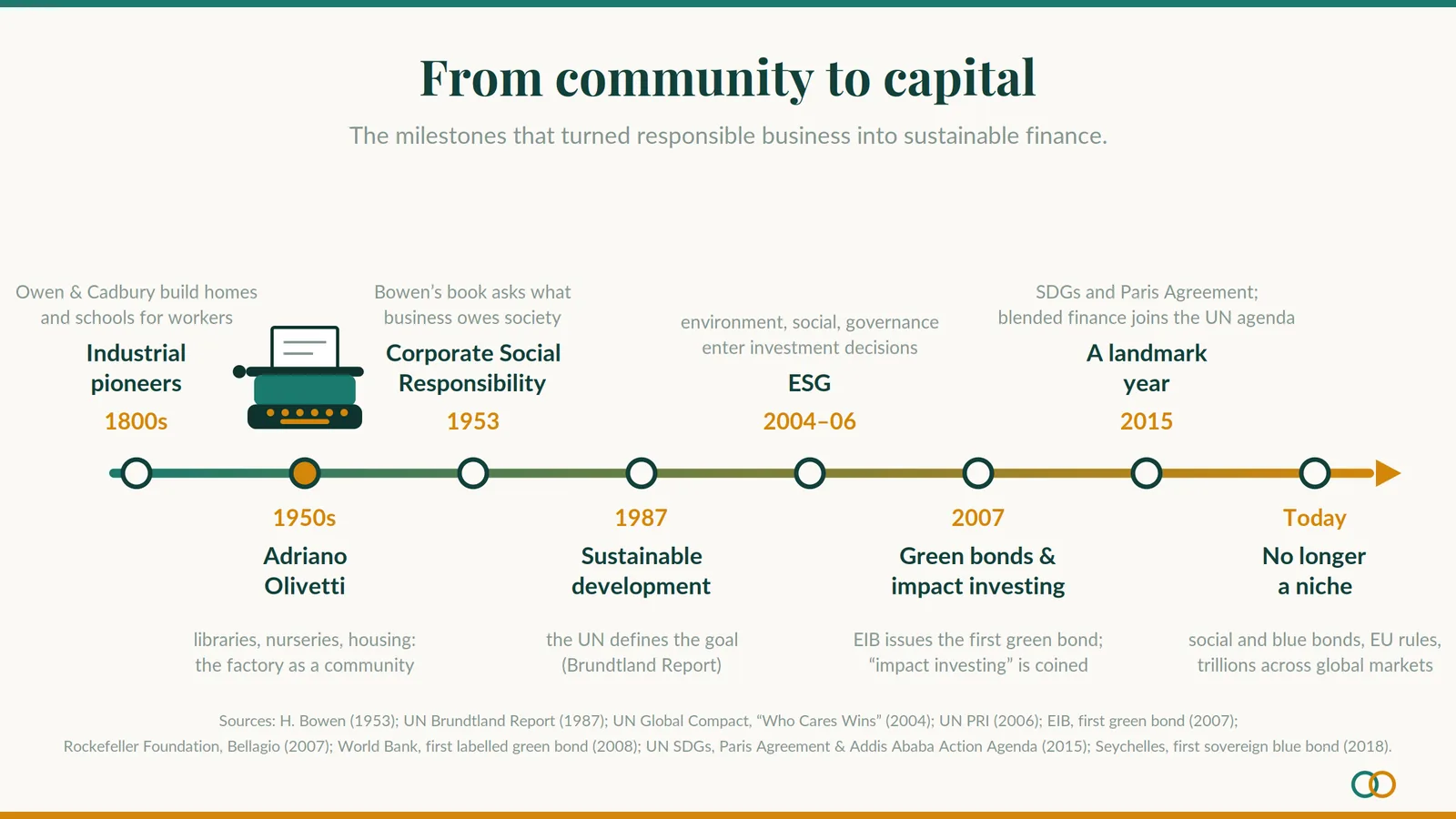
The story begins before sustainable finance had a name. For decades, businesses drove growth, created jobs and generated prosperity, often without fully accounting for their social and environmental impact. Many of those costs remained invisible or were ultimately paid by society. Over time, companies began to recognise that long-term success depends on more than financial performance. How they treat employees, communities and the environment is not only an ethical issue; it can also affect the resilience and success of the business itself. This thinking evolved through corporate social responsibility and, later, ESG: the systematic consideration of environmental, social and governance factors. Some leaders understood this much earlier. As an Italian, I cannot tell this story without mentioning Adriano Olivetti, who was a genuine game changer. In the 1950s, he built a highly innovative company while offering workers better wages, libraries, nurseries and social services. He showed that business success and responsibility towards people and communities did not have to be in conflict.
Alongside business, society has always relied on another mechanism: governments, charities and philanthropic foundations. Their role has always been essential. Many problems simply cannot be solved through markets. But over time the scale of the world's challenges grew enormously. Climate change, biodiversity loss, poverty, healthcare, education. Meeting them requires investments measured in trillions of dollars every year. Public budgets and philanthropy remain indispensable, but on their own they are simply not enough.
And this is where the story becomes interesting. Instead of asking only "how can we donate more money?", people started asking "how can we invest money differently?" Finance stopped being something separate from the world's problems and became one of the tools to help solve them. This, for me, is where sustainable finance begins. That simple idea grew into a family of tools. Green bonds, which let governments and companies borrow specifically for climate and environmental projects (they now have social and blue cousins too). Blended finance, where public or philanthropic money takes the riskiest part of an investment so that private investors can join. And impact investing, which deserves a closer look. Sustainable finance is a broad umbrella. Impact investing is a specific approach underneath it, where investors intentionally seek measurable social or environmental outcomes alongside a financial return. Some approaches take this one step further. In outcome-based finance, payments are tied not to activities but to results actually achieved: children who learn, patients who recover, emissions that fall. It changes the question from "what did we fund?" to "what did we actually change?" To me, that question is where this whole field is heading.
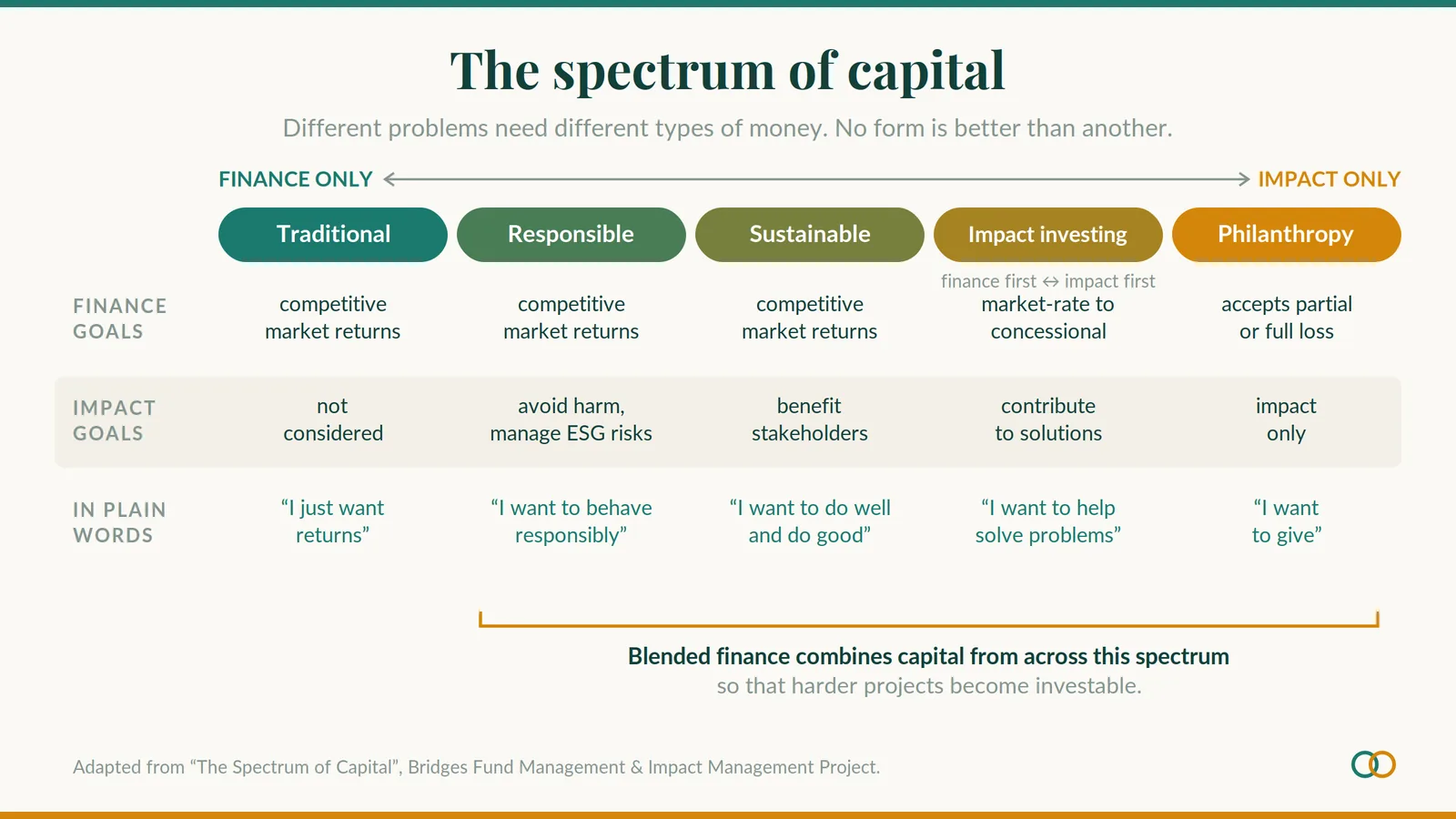
One misunderstanding deserves its own paragraph. Many people assume that sustainable finance means giving up returns, as if doing good and earning money were a trade-off by definition. It is not. Most sustainable investment targets ordinary market returns; a well-run wind farm is simply a good asset. And where investors do accept lower returns, in philanthropy or in catalytic blended finance, it is a deliberate choice with a purpose, not a sacrifice by accident. The question is never profit or impact. It is what each euro is trying to achieve.
People in my field often talk about the spectrum of capital. On one side, philanthropy, which expects nothing back. On the other, commercial investing, which seeks the best possible return. In between sit sustainable finance, blended finance, impact investing etc. No form of capital is better than another. Different problems require different types of money, and no single approach can solve everything.
So what do I actually do, inside all of this? Many people think finance is only about money. I have come to see it as connecting worlds. My work requires understanding economics, finance, and financial markets, but also public policy, social and environmental science, ethics, law and human sciences.
I work with governments, investors, foundations, development banks, NGOs and technical experts to design financial solutions that move capital towards projects with positive environmental and social outcomes.
To me, it is one of the most fascinating jobs I can imagine, because no single discipline is enough, and there is always something new to learn.
Let me be honest. Sustainable finance is not a perfect solution, and it will not solve every global challenge. Markets have limits. Governments have limits. Philanthropy has limits. But when these different forms of capital work together, they achieve far more than any one of them could alone.
If there is one thing I hope this story makes clearer, it is that finance is never just about money. It influences which businesses grow, which projects are built and which problems receive attention. Sustainable finance and impact investing are about using that link more deliberately, directing capital towards outcomes that matter. My role is to help make that happen: connecting finance, policy and real-world needs so that good ideas can become investable and, ultimately, deliver impact.
Of course, in real life there is rarely time to explain all of this. So when someone asks me what I actually do, I usually just smile and say: "I help money do more than one job at a time." And when they look confused, well, now I can send them this.